
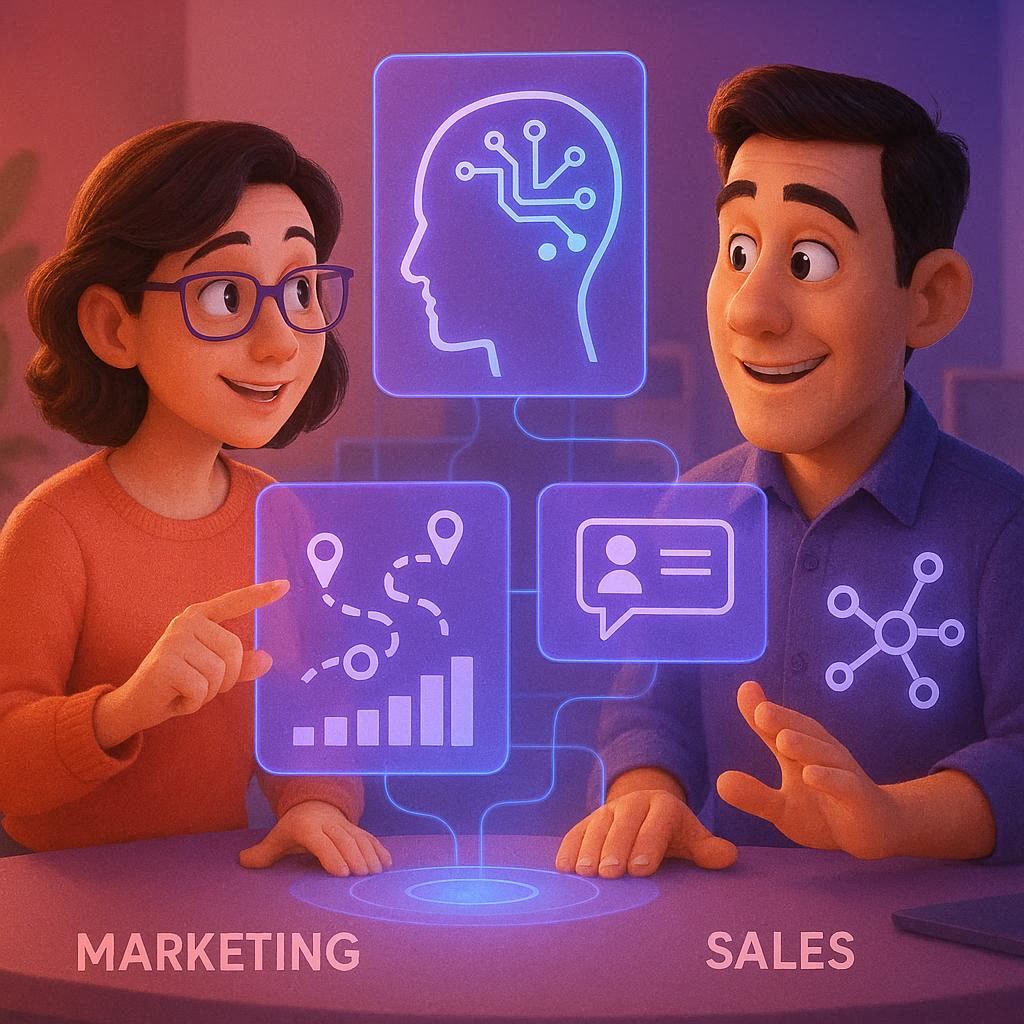
In the current B2B scenario, the integration between digital marketing and sales ceased to be a differential and became essential for competitive survival. Studies show that organizations with strong alignment between these areas grow faster, both in revenue and in operational efficiency.
However, many teams still operate in isolation, with fragmented data, different metrics, and little collaboration - which generates noise, disjointed messages, and lost opportunities.
In this context, tools and systems capable of unifying communication data, behavior, and signs of intent - such as the **Nuvia Platform - become fundamental for companies to build effective, predictable, and scalable business operations.
The integration between marketing and sales goes far beyond simply passing leads from one team to the other. It means:
Without this integration, even the best marketing campaigns may not result in sales. Close to 60% to 70% of all content created by B2B marketing teams is never used for sales due to the lack of data integration and communication.
This demonstrates that, even with investments in content production, many leads are not converted simply because there is no “common thread” between intent and business approach.
Educators and market consultancies have repeated this fact with numbers:
These numbers aren't just isolated metrics — they show that integrating, sharing data, and acting in a coordinated way results in better customer experience, greater commercial efficiency, and better use of investments in content and prospecting.
The lack of integration has a real cost:
In addition, fragmented communication between teams causes frustration, rework, and duplication of efforts - for example, when marketing creates content for a specific profile, but sales don't use it due to lack of alignment with the buyer's stage that the content is for.
With the growth of digital interactions, B2B buyers began to complete a large part of their buying journey before even speaking to a seller. Reports suggest that even 80% of B2B sales interactions will be digital by 2025, which requires marketing and sales to speak the same language - guiding the buyer from the first contact to closing.
At the same time, data indicate that 93% of shoppers consider personalized experiences important during the buying journey, and 96% want communication adapted to their interests.
These numbers make it clear that a modern buyer You don't want generic messages, and that the unification of teams and systems is critical to delivering contextual experiences that truly convert.
Personalization goes beyond using the lead's name in an email. It's about:
This type of personalization is only possible when marketing and sales share:
When this information flows between teams, companies are able to create a Integrated working day, rather than fragmented, resulting in greater lead trust and a greater chance of conversion.
According to market data, teams that are able to align marketing content with sales needs increase by up to 73% conversion rate.
Even knowing that integration increases performance, many companies face practical difficulties:
When marketing uses tools and dashboards that sales don't see, the data is fragmented.
Without defined routines and SLAs, leads are sent without context and without clear criteria, generating frustration.
Marketing focuses on MQLs, clicks, and engagement, while sales focuses on SQLs, conversions, and forecasting. Without shared KPIs, there is misalignment.
Teams that don't collaborate, don't share data or goals, tend to work in isolation.
A Nuvia platform was designed for make this integration between digital marketing and sales not only possible, but automatic and intelligent.
Nuvia centralizes all lead data, digital behavior, fit scores, and signs of intent in one place - eliminating silos and allowing both teams to work with the same vision.
Nuvia agents execute campaigns based on qualified data that serve both marketing and sales, ensuring:
Every interaction is recorded and synchronized with your CRM, ensuring that:
This convergence makes the process less manual, more precise and much more efficient, eliminating rework and waste.
When marketing and sales work together with data and automation, the results are clear:
Companies with well-structured alignment can grow 20% per year, while those with silos miss opportunities and see a drop in efficiency.
In addition, teams that share data and goals achieve higher closing rates and better customer experience, vital for loyalty.
The data shows that companies with robust integration between digital marketing and sales perform significantly better than those that keep these teams isolated.
Automation with artificial intelligence, when applied together with personalized communication based on real data, allows:
And that's exactly what Nuvia offers with its AI Agents ALLBOUND — a growth operating system that integrates marketing and sales with intelligence, automation, and continuous personalization.
If your company still operates with separate teams, disconnected data, and the absence of a unified strategy, the competitive advantage lies precisely in changing that now - with technology, data, and AI