
Tecnologia de IA

Revenue OS in practice: how to integrate data, AI, and execution to generate predictable growth with Nuvia

Revenue OS in practice: how to integrate data, AI, and execution to generate predictable growth with Nuvia

Introduction: Growth is no longer about strength — it's about system

For over a decade, companies tried to scale sales with a simple logic: hiring more salespeople, increasing cadence volume, feeding the top of the funnel with more leads.

That model worked.
Until it stopped.

The modern buyer was saturated.
The channels became noisy.
The lists were out of date.
The teams were overwhelmed.
And the operations were unpredictable.

At that point, many companies understood the hard truth:

There is no scalable growth without a system.

This is how the global concept of Revenue Operating System (Revenue OS).

And now, in Brazil and LatAm, this model is getting its operational version with Nuvia.

This article explains how it works in practice:

  • What is Revenue OS
  • Why did it grow so much
  • How does it integrate marketing, SDR, and sales
  • And how does Nuvia deliver this model from end to end
  • transforming companies with AI, Data, and Intelligent Automation

Get ready: this is the type of content that changes the way you think about business operations.

1. Whats Revenue Operating System — and why it became a new market standard

Revenue OS is not a tool.
It's not a CRM.
It's not automation.
And it's not isolated AI.

He is the structure that connects data, automation, processes, and people, ensuring:

  • continuous flow between Marketing → SDR → Sales
  • centralized data
  • intelligence applied at each stage
  • synchronized execution
  • constant learning
  • Revenue predictability

In the traditional model, each area operates separately, with different tools and conflicting objectives.

Revenue OS fixes this when creating a unique growth system, where:

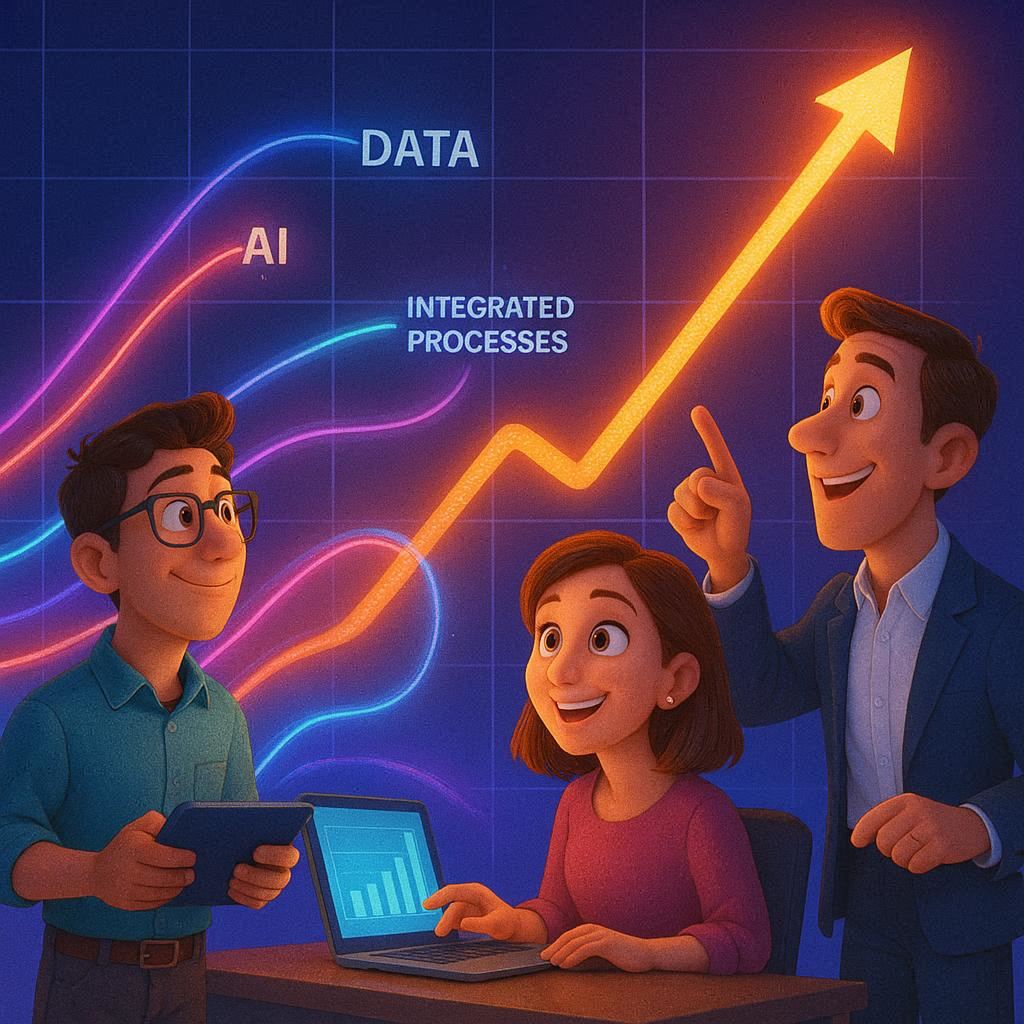
  • Data fuels AI
  • AI automates operations
  • Do operations generate signals
  • Signs generate intelligence
  • Intelligence improves processes
  • processes generate predictability

It transforms sales from a manual process into an engine that works alone.

2. Why companies migrated to Revenue OS — the 5 global triggers

Trigger 1 — Data volume explosion

Today there is more data than any team can process.
Without AI, most of it becomes noise.

Trigger 2 — Channel Saturation

Email, LinkedIn, WhatsApp — all overcrowded.
Personalization became mandatory.

Trigger 3 — Leads that are less and less patient

48% of leads buy from the company that answers first (Harvard Business Review).
AI eliminates that delay.

Trigger 4 — Increase in human cost

SDRs, analysts, operators.
Each hire is expensive and does not scale.

Trigger 5 — Pressure for predictability

Investors, CFOs, and CEOs want real forecasts — not “guesses”.

The sum of these factors caused the manual sales model to collapse.

3. The 4 pillars of a modern Revenue OS

To work well, a Revenue OS needs four operational pillars, which Nuvia delivers in a unified way:

3.1 Unified and Dynamic Data

A centralized system capable of:

  • Map ICP
  • create qualified lists
  • Enrich contacts
  • identify decision-makers
  • Monitor signs of intent
  • Prioritize accounts by fit

That's the heart of any operation.

3.2 Intelligent Execution Automation

Here come in the AI Agents Allbound, that:

  • Do inbound leads respond
  • Conduct conversations
  • Create cadences
  • Send personalized messages
  • Engage on WhatsApp
  • Connect via LinkedIn
  • Nurture leads
  • Update CRM

They perform repetitive work - leaving the human team with the most impactful interactions.

3.3 Continuous Learning

Every message sent, response received, qualified lead, and action taken generates new data.

This data feeds back into the system, causing:

  • The ICP becomes more accurate
  • Decision-makers are found faster
  • Personalization improves
  • Engagement goes up
  • The conversion increases

Revenue OS gets smarter with each cycle.

3.4 Revenue Predictability

Finally, all of this connects to the actual result:
pipeline and revenue forecasting with high accuracy.

Marketing begins to measure intent.
SDR now measures real conversations.
Sales now measure qualified deals.
And the CFO starts to measure predictability.

4. How Nuvia delivers Revenue OS in practice (and why it matters)

Unlike isolated tools (whether CRM, automation, or chatbot), Nuvia delivers the complete system, combining:

  • Proprietary Platform
  • AI Agents Allbound
  • Data Intelligence
  • Automated Operational Execution
  • Integration with CRM
  • Continuous Learning

The result?
A stand-alone revenue engine.

5. Nuvia's before and after operation — realistic comparison

BEFORE

• Overloaded SDRs
• Manual, generic and slow outbound
• Inbound with no response
• Unintentional leads
• Outdated CRM
• Low conversion
• Inconsistent forecast
• Disconnected Marketing and Sales

THEN (with Nuvia's Revenue OS)

• AI identifies the right accounts
• Agents create qualified lists
• Personalized multichannel messaging
• AI responds and qualifies inbound
• Pipeline grows with real intent
• 24/7 execution
• CRM updated automatically
• Real revenue predictability

This change is so profound that, after 90 days, companies report:

  • Increase of 35% to 60% In conversions
  • Reduction of 40% to 55% No CAC
  • Decrease of 70% in manual tasks
  • sales cycle reduced by 20%
  • SDRs up to 5x more productive

It's not a miracle.
It's a system.

6. The role of each area within Nuvia's Revenue OS

Marketing:

  • Generate intent
  • Optimizes content
  • Feed AI Agents with signals
  • Map dynamic ICP
  • Improve inbound channels

SDR:

  • Receive already qualified leads
  • Conduct deep conversations
  • Prioritize humans for valuable interactions

Sales:

  • Get ready opportunities
  • Closes faster
  • Revenue forecast increases

C-Level/RevOps:

  • Follow real indicators
  • Reduces operating cost
  • It increases predictability

7. How the Nuvia Revenue OS cycle works — step by step

1. Data enters the system

Lists, accounts, signs, behavior, history.

2. AI analyzes and prioritizes

Fit, intention and time of purchase.

3. AI Agents Execute

Multichannel, customized, scaled.

4. Leads are qualified

Intelligently and automatically.

5. Opportunities go to CRM

With full history.

6. Sales close

With more efficiency and less friction.

7. Results feed back the system

Continuous cycle.

That's how Revenue OS gains strength — the more it runs, the smarter it gets.

8. The 5 biggest mistakes made by companies trying to grow without a Revenue OS

  1. Lots of software, few results
    Disconnected tools don't scale.

  2. Depend on human effort for volume
    It's expensive, slow, and inconsistent.

  3. Poorly defined ICP
    It generates poor lists and disqualified leads.

  4. Lack of personalization
    The modern shopper ignores generic messages.

  5. Zero predictability
    Teams sell but can't predict the pipeline.

Revenue OS solves all of these points at the root.

9. Why is the entire market migrating to models like Nuvia

Three major movements explain this shift:

  1. AI has become mainstream
    It's no longer a differential—it's an obligation.

  2. Non-Humans-on-Low-Value
    Human teams focus on what generates real impact.

  3. Efficiency-oriented growth
    Companies want to grow without multiplying headcount.

Those who don't integrate AI will compete at a brutal disadvantage.

10. The future of the market: autonomous operations and AI-LED

What we're seeing now is just the beginning.

Over the next few years, we'll see:

  • 90% automated pre-sales
  • Chatbots evolving into operational agents
  • Auto-completed CRM by AI
  • hyper-relevant outbound
  • deep personalization by segment
  • fully adaptive funnels
  • AI Agents collaborating with humans

And Nuvia is already paving that path in Brazil and Latin America.

Conclusion: Revenue OS is not the future — it's the present for those who want to grow with predictability

Companies that rely on manual effort and departmental silos face:

  • high costs
  • low conversion
  • unpredictability
  • Overloaded teams
  • Weak pipeline

Meanwhile, companies operating with Revenue OS and AI Agents:

  • They grow with less effort
  • Scale with consistency
  • They increase predictability
  • Reduce CAC
  • Improve conversion
  • Build a competitive advantage

The question now is:

Does your company still operate with isolated tools - or is it ready to run with a Real Revenue Operating System?

If the answer is still the first option, Nuvia may be the missing engine to transform your operation.